ℹ️ Click on the + to view the trail info.
🥾 Trail Info 🔽
- 📍 Start and End: The hike starts at the small hamlet of Selden near the Gasthaus Steinbock in the rear Gasterntal valley. A reservation bus takes visitors to this point, and booking in advance is highly recommended.
This is a one-way hike and ends at the train station in Kandersteg. - 🚗 Access & Reservation: IMPORTANT! The reservation-only shuttle bus to the Gasterntal must be booked in advance, as each departure has only around 15 seats available. Access by car is via the narrow Chlusestrasse, which includes very tight sections and time-controlled one-way traffic. It is only recommended for experienced drivers. Parking is available directly at
Kandersteg railway station. - 💰 Costs: There is no fee for the hike itself. The reservation-only shuttle bus to the Gasterntal costs CHF 15 per person (one way), while children pay CHF 10. Additional parking fees may apply in Kandersteg.
- 🚆 Public Transport Access: This hike is ideal as a public transport hike, as both the starting point and the endpoint are easily accessible by train via Kandersteg.
- 🚶♂️ Distance: The route from the rear Gasterntal valley to Kandersteg is around 9.5 kilometers (5.9 miles). Including the detour to Geltenbach Falls, you should plan for approximately 10 kilometers (6.2 miles).
Starting and ending at the train station is also possible, but this would extend the total distance to nearly 20 kilometers (12.4 miles). - ⏱️ Duration: The pure hiking time is approximately 3 hours. Including photo stops, breaks, and the detour to the Geltenbachfall, you should plan for a total of 4 to 5 hours. This makes the tour an ideal relaxed half-day hike in the Bernese Oberland.
- 📊 Elevation Gain & Loss: Elevation gain is 130 meters (427 feet) | Elevation loss is 490 meters (1,608 feet).
- 🥵 Difficulty: Easy to moderate (T1 – Swiss Alpine Club scale). The route is mostly downhill with around 490 meters (1,608 feet) of descent. After heavy rainfall, the Kander River can rise quickly, and there is a potential risk of rockfall along steep cliff sections.
- 📆 Best Season: The hike is ideal in summer and late summer through early autumn. The Gasterntal becomes especially beautiful when the first trees begin to change color and the landscape glows in warm autumn tones.
- 🌿 Trail Surface: Around 8 kilometers (5 miles) follow well-maintained hiking trails with gravel and natural terrain. The remaining approximately 2 kilometers (1.2 miles) run along paved side roads in the upper Gasterntal area and toward Kandersteg.
- 🥾 Equipment: Sturdy hiking shoes with good grip are recommended. Hiking poles can help reduce strain during the longer descent. Bring enough water and snacks, as there are very limited refreshment options along the route. Don’t forget sun protection.
- 👨👩👧 Family-Check: The hike is well suited for families with children, as there is hardly any elevation gain and mainly around 490 meters (1,608 feet) of descent. The route follows regular hiking trails and is not suitable for strollers. In the Chluseschlucht section, the road can be used as an alternative, but it is very narrow and only suitable to a limited extent.
- 🐕 Hiking with Dogs: The hike is suitable for dogs, as the trails are wide and technically easy. However, since the Gasterntal is a protected nature area, dogs must be kept on a leash to protect rare plants and wildlife. In the lower part of the valley, you will also encounter free-roaming cows.
- 📌 Signposts & Markings: The route is consistently well signposted. Follow the yellow hiking signs toward Kandersteg or the green route “56 – Lötschberg Panorama Trail.” It is an easy, yellow-marked hiking trail (T1 – Swiss Alpine Club scale).
- 📶 Mobile Reception: Mobile phone coverage in the Gasterntal ranges from weak to non-existent, depending on the section of the valley. It is recommended to download maps or GPS data offline before starting the hike.
- 📸 Best Photo Spots: One of the highlights is the detour to the Geltenbachfall at the very beginning of the hike, including the suspension bridge over the Kander River. However, the entire trail offers countless impressive photo opportunities, with towering cliffs, cascading waterfalls, and wide valley views. In some sections, it almost feels like a quieter version of Lauterbrunnen. Please note that drones are prohibited, as parts of the Gasterntal are located within a protected nature area.
- 🦌 Wildlife: In the Gasterntal, we were able to spot a chamois in the distance, seemingly climbing an almost vertical rock face with ease, an impressive sight. Birds of prey also regularly circle above the valley, including eagles whose calls echo dramatically between the towering cliffs.
- 🌄 Highlights: The highlight of this hike is the untouched Gasterntal with its pristine natural landscape. The wild Kander River accompanies you throughout the entire route all the way to Kandersteg. With its steep rock walls and numerous waterfalls, the valley in some sections feels like a quieter version of Lauterbrunnen.
If you’re looking for more spectacular landscapes around Kandersteg after this hike, the Oeschinen Lake panorama hike is highly recommended. It’s located just a few kilometers away and offers stunning views over the turquoise lake. - 💡 Tips: Reserve your seat on the reservation bus from Kandersteg early, as each trip has only around 15 seats available. If you don’t secure a spot, you may have to wait for the next departure.
For the best lighting conditions, it’s recommended to start the hike from midday onwards, as the sun stays behind the steep rock walls for much of the morning. A late afternoon start offers especially beautiful and atmospheric light. - 🏡 Accommodation & Restaurants: At the starting point in Selden, you will find guesthouses and restaurants with overnight accommodation. After that, there are no further dining options until you reach Kandersteg. Along the route, however, there are several official barbecue areas and quiet spots perfect for taking a break and enjoying the alpine scenery.
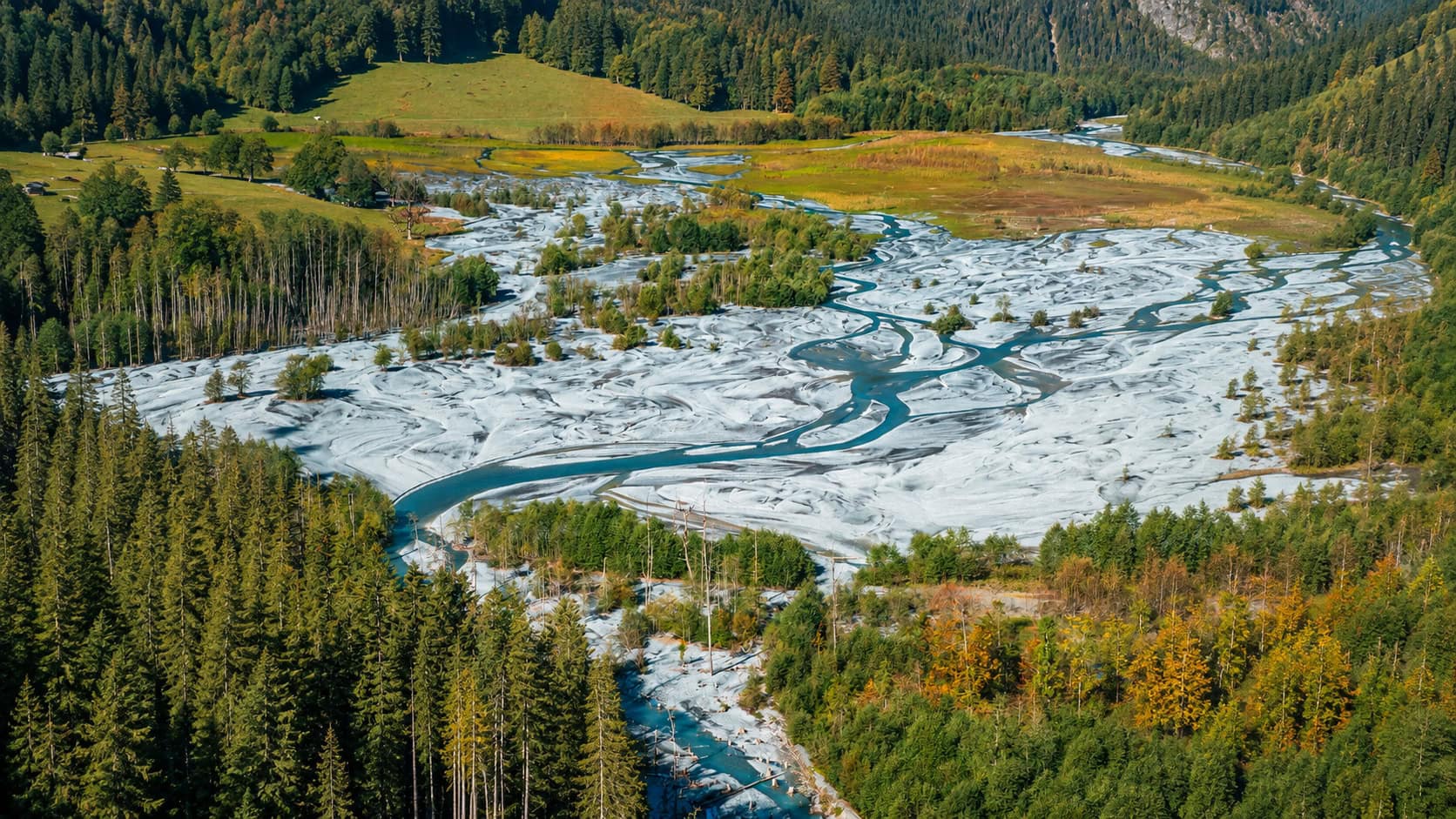
The Gasterntal feels like a forgotten world. Towering rock faces rise steeply on both sides, the wild Kander River rushes through the valley, and the deeper you travel into it, the more civilization seems to disappear.
When we planned this hike, the SBB app showed a bus connection directly into the Gasterntal. Perfect, we thought so we saved the route and set off. Once in Kandersteg, we boarded the small shuttle bus, only to be told that without a reservation we had no seat. Fortunately, two spots had just become available, and after a short conversation with the driver, we were lucky enough to join the ride.
Our recommendation: Be sure to reserve your seat in advance through Kander-Reisen. The shuttle bus is small, and seating is very limited.
Die Fahrt ins Gasterntal war spektakulär. Die schmale Strasse schlängelt sich durch das Tal, vorbei an Felswänden und engen Passagen. Der Fahrer kannte jede Kurve, jede Engstelle, man merkte sofort, dass er diese Strecke täglich fährt. Nach rund einer halben Stunde erreichten wir den Endpunkt der Buslinie und damit den Start unserer Wanderung im hinteren Gasterntal: das kleine Selden. Ein paar Gasthäuser, einige Bauernhöfe, viel mehr gibt es hier nicht. Und genau das macht den Reiz aus.

Right at the beginning of the hike, you have the option to turn left and take a short detour to a nearby waterfall and of course, that’s exactly what we did. The trail first led us across a suspension bridge over the Kander River.
On the other side, a short but steep road climbs up toward the waterfall. Unfortunately, there was construction work in the area, and the waterfall was partially obstructed. A section of the path was also closed, as we were hiking shortly after a heavy thunderstorm and an extended period of rainfall.

After our short detour, the weather quickly cleared, and the dark clouds were replaced by bright blue skies the perfect moment to begin the actual hike. The signpost indicated three hours to Kandersteg, which seemed realistic to us.
We followed the green sign marked number 56, the “Lötschberg Panorama Trail,” as it almost perfectly matched our planned route. We had already reviewed the trail in advance: for long stretches, it leads gently downhill with only minimal elevation changes. It is only near the Chluseschlucht that the terrain becomes steeper, where the main descent toward Kandersteg begins.

The first two kilometers (1.2 miles) followed the road, which didn’t bother us at all. In late summer, almost early autumn, the temperatures were ideal — not too hot, not too cold, perfect for easing into the hike.
With every step, the valley opened up more and more before us. The scenery reminded us of a wilder, quieter version of Lauterbrunnen: towering rock walls on both sides, the Kander River flowing through the middle, and countless waterfalls plunging down from above. Some of them would accompany us more closely as the hike continued.
If you are looking for a hike entirely focused on waterfalls, we also recommend our Waterfall Arena Batöni hike one of the most impressive waterfall landscapes in Eastern Switzerland.
Important for your planning: Make sure to buy your food and supplies in Kandersteg before starting the hike. There are no grocery stores in the Gasterntal, only a few scattered guesthouses. All the more surprising were the numerous official barbecue areas along the trail a lovely detail in a valley that otherwise feels almost untouched.

After around two kilometers (1.2 miles), the scenery changed noticeably. The road transitioned into a narrower hiking trail that led us through a light forest. Between the trees, the view repeatedly opened up toward the valley, revealing the towering rock faces rising dramatically on both sides.
Eventually, we left the forest behind and stepped back into the open expanse of the Gasterntal. Here, the valley revealed its full dramatic character.
From this point on, the Kander River accompanied us all the way down toward Kandersteg. The river felt wild and untamed, especially after the recent rainfall. There was hardly any shade left, as the sun was already high in the sky, casting strong light across the entire valley.


As we were hiking shortly after a severe storm, the valley revealed its powerful side. In several places, the trail had been damaged and had to be rerouted. It was a clear reminder of how intense and dynamic nature can be in the Gasterntal.
At the same time, that is exactly what made it so special. We crossed the Kander several times over narrow bridges, while countless waterfalls cascaded down the steep rock faces around us. The constant sound of rushing water accompanied us throughout this section of the hike.
We stopped at one of the official barbecue areas for a break. Sitting on a simple wooden bench with a view of the wild Kander and a waterfall plunging down in the background felt almost surreal. In moments like these, you realize how little it takes to feel truly happy: fresh mountain air, good food, and a landscape that seems almost unreal.

After around five kilometers (3.1 miles) on an easy and enjoyable trail, we reached a small clearing. A signpost pointed left toward another waterfall and for us, it was immediately clear that we would take this detour as well. In a valley like this, we truly wanted to explore every corner.
The closer we got to the waterfall, the wilder the scenery became. More and more rocks were scattered across the trail, and the warning signs with the rockfall symbol reminded us that nature here is constantly in motion. Honestly, that sign always makes us pause for a second. Hiking beneath towering rock faces carries a sense of awe and perhaps a small touch of adrenaline as well.

The detour was absolutely worth it. The Geltenbachfall is truly impressive: with a height of around 70 meters (230 feet), the water plunges powerfully into the depths below. The spray filled the air and provided a refreshing cool-down, as temperatures were well above 20°C (68°F).
What makes it even more fascinating is that the Geltenbach emerges from a cave higher up the cliff, making it a karst spring. The water disappears into the rock underground and reappears elsewhere a remarkable natural phenomenon in the Bernese Oberland.
The Gasterntal is rich in waterfalls overall. From the steep rock walls some rising over 1,000 meters (3,280 feet) countless streams plunge into the valley below. Many of them are seasonal and carry especially impressive volumes of water after heavy rainfall or during the snowmelt.
That is exactly what makes this valley so spectacular. After storms, the scenery can feel almost dramatic, with dozens of waterfalls cascading down the cliffs at the same time.
It’s no wonder that, at times, it felt like a second Lauterbrunnen to us just more untouched and far quieter.

After returning to the main route along the same path, we left the forest behind for good. Ahead of us, a wide meadow opened up and we were no longer alone. Several cows were roaming freely around us, sharing the hiking trail through the Gasterntal.
Earlier, we had already crossed a pasture fence, which prepared us for the fact that we were now entering an active grazing area. In general, the animals are calm and used to hikers, but it’s important to keep a respectful distance. Extra caution is advised when hiking with a dog, as cows can be very curious yet may react unpredictably if they feel unsure or threatened.

After around two hours, we reached the lower part of the Gasterntal. At the first guesthouse, a sense of civilization returned and after the long stretch through untouched alpine nature, it almost felt unusual.
We treated ourselves to a well-deserved ice cream and enjoyed a short break before continuing our hike. Soon, the trail led back into the forest, and the landscape became narrower and more dramatic. The Chluse gorge was approaching. A completely different section of the tour, defined by steep rock faces and a noticeably wilder atmosphere.

A true highlight for us was the Chluse-Gorge, also known as the Klus-Gorge. Here, the Kander River merges with the Schwarzbach, significantly increasing the river’s power and intensity. The impressive gorge section begins at a historic stone arch bridge that has stood for around 100 years.
Shortly afterward, we crossed another bridge and what followed was spectacular. A narrow suspension bridge led directly over the roaring Kander River. Beneath us, the water churned and foamed, and we could feel the raw power of the current. After this thrilling moment, the trail continued up a series of steps carved into the steep rock face, leading us through the heart of the gorge.
Important to know: The road through the gorge is single-lane and, in the upper section, operates with time-controlled one-way traffic. Driving up here is definitely not for the faint of heart.


At this point, the route splits: you can either follow the road downhill or take the official hiking trail through the forest, which brings you closer to the Kander River once again.
Curious about the view, we initially chose to follow the road for a short stretch. The scenery was spectacular. From above, a sweeping panorama opened up across the entire valley all the way to Kandersteg. However, passing cars and the narrow roadside made hiking there less enjoyable.
After reaching the best viewpoint overlooking Kandersteg, we turned back and took the hiking trail down instead. There, we were once again closer to nature, away from traffic, and able to enjoy the final kilometers of this Gasterntal hike at a relaxed pace.

The hiking trail downhill is steep in sections, yet the Kander River constantly accompanies you as you descend. The sound of the rushing water makes the descent feel even more dramatic and almost distracts from the effort.
By now, it was late afternoon, for us, the most beautiful time of the day. The light became softer, the rock faces began to glow, and the atmosphere in the valley felt almost magical. These are exactly the moments we love to capture and remember.
Along the way, we spotted the Sunnbüel cable car, which we plan to explore in more detail and feature in a separate blog post in the future. This hike fits perfectly into our “Hidden Gems” category, where we highlight unique and lesser-known hiking trails in Switzerland.

As we reached the outskirts of Kandersteg, the landscape changed once again. The trail led across wide meadows, and after the steep descent, the softer ground felt incredibly soothing on our feet. It was one of those moments when you truly feel that the effort has been worth it.
In the distance, we spotted the cable car leading up to the world-famous Oeschinensee. After around three hours of hiking, we were slowly approaching the end of the tour. As it was already late afternoon, it quickly grew darker, with the sun disappearing behind the surrounding mountains.

Along the way, we discovered a small chalet with a self-service kiosk offering various regional products. These little roadside stands are simply part of the Swiss hiking experience for us.
If you love cheese, we can only recommend trying locally produced mountain cheese from regional farmers. Made with great care and rich in flavor, it’s hard to beat. For us, authentic Swiss mountain cheese is among the best in the world.
Of course, we couldn’t resist and bought a small piece before continuing our hike toward our final destination, Kandersteg railway station.


The final kilometers felt a bit long, but just then the valley gifted us one last magical moment: the sun dipped behind the mountains, bathing the towering cliffs in warm light, while the Kander continued to rush beside us. It was a worthy, almost cinematic ending to an unforgettable day in the Gasterntal.
For us, the Gasterntal hike ranks among the most beautiful trails around Kandersteg. Peaceful, untouched, and full of raw alpine power, it feels like a hidden gem that too often stands in the shadow of more famous destinations. More than once, we were reminded of the Lauterbrunnen Valley just quieter and wilder.
A small planning tip: The shuttle bus access is not clearly signposted, and without a reservation, seats can fill up quickly. Be sure to plan this in advance.
Now we’re curious: Have you already explored the Gasterntal? Do you have your own tips or memorable moments from this hike? Feel free to share them in the comments — we’d love to hear from you and exchange experiences.
If you’re looking to experience even more after this hike, another highlight is waiting just nearby. Only a few kilometers away, you’ll find the Oeschinen Lake panorama hike, one of the most beautiful hikes in Switzerland with stunning views over the turquoise Oeschinen Lake. The starting point is also easily accessible via Kandersteg, making it perfect to combine both hikes.
Details and Elevation Profile
Frequently Asked Questions about the Gasterntal Hike in Kandersteg
ℹ️ Click on the question to view the answer.
The Gasterntal can be reached from Kandersteg either by reservation-only shuttle bus or via the narrow Chlusestrasse road. The shuttle bus must be booked in advance, as each departure has only around 15 seats available.
Yes, a reservation is strongly recommended. Without booking in advance, you may not get a seat and might have to wait for the next departure.
The pure hiking time is around 3 hours. Including breaks, photo stops, and the detour to the Geltenbachfall, you should plan for a total of 4 to 5 hours for this Gasterntal hike.
The tour is rated easy to moderate (T1 – Swiss Alpine Club scale). It is mostly downhill with around 490 meters (1,608 feet) of descent. Technically, the trail is straightforward, but extra caution is advised after heavy rainfall or in areas with potential rockfall.
The distance is approximately 9.5 kilometers (5.9 miles). Including the detour to the Geltenbachfall, the total distance is about 10 kilometers (6.2 miles).
Yes, the Gasterntal hike is suitable for families with children, as it is mostly downhill. However, the trail is not suitable for strollers.
Yes, the Gasterntal hike is suitable for dogs. However, since the valley is a protected nature area, dogs must be kept on a leash. In the lower part of the valley, you may also encounter free-roaming cows.
Summer and late summer through early autumn are ideal for the Gasterntal hike. The valley is especially beautiful when the first trees begin to change color and the many waterfalls carry impressive amounts of water after rainfall.
At the starting point in Selden, there are guesthouses and restaurants. After that, there are very limited refreshment options until you reach Kandersteg. However, along the trail you will find several official barbecue areas where you can take a break.
The highlights of the Gasterntal hike include the impressive Geltenbachfall, the dramatic Chluseschlucht with its suspension bridge, the wild Kander River, and the steep rock faces lined with countless waterfalls. In some sections, the valley feels like a quieter version of Lauterbrunnen just far less crowded and more untouched.